

A 24-hour general strike has been called across Spain, including Catalonia, for Wednesday 11 November. It is led by the CCOO and UGT unions, with support from other unions, and the main demands are about housing and wages. If you have employees, you may need to reorganise work that day and adjust November’s payroll afterwards. Here is what you need to know:
What happens on the day?
Employees on strike
€0
Their contract is suspended: they are not paid for the strike hours and no contributions are due for them
Employees who work
100%
They work as usual and receive full pay. That is why the workplace must stay open
What can you do before the 11th?
What you cannot do on strike day
| Action | Legal basis |
|---|---|
| Hiring outside staff or a temporary work agency to cover striking employees | Art. 6.5 of Royal Decree-Law 17/1977 and art. 8 of Law 14/1994 on temporary work agencies |
| Assigning other employees to strikers’ tasks outside their usual duties (known as internal strike-breaking) | Right to strike (art. 28.2 of the Constitution), as interpreted by the courts |
| Closing the workplace | Art. 12 of Royal Decree-Law 17/1977: only in exceptional cases |
| Disciplining or dismissing someone for going on strike | Art. 6.1 of Royal Decree-Law 17/1977 |
| Using technical means you do not normally use to cancel out the strike | The courts are divided and it depends on the case. Ask us first |
Replacing strikers with people from outside the company is a very serious offence under art. 8.10 of the Spanish Law on Social Order Infringements and Penalties (LISOS), with fines from €7,501 to €225,018. Any penalty or dismissal for striking can also be declared null and void.
The timeline at a glance
These are the four points at which the employer needs to act:
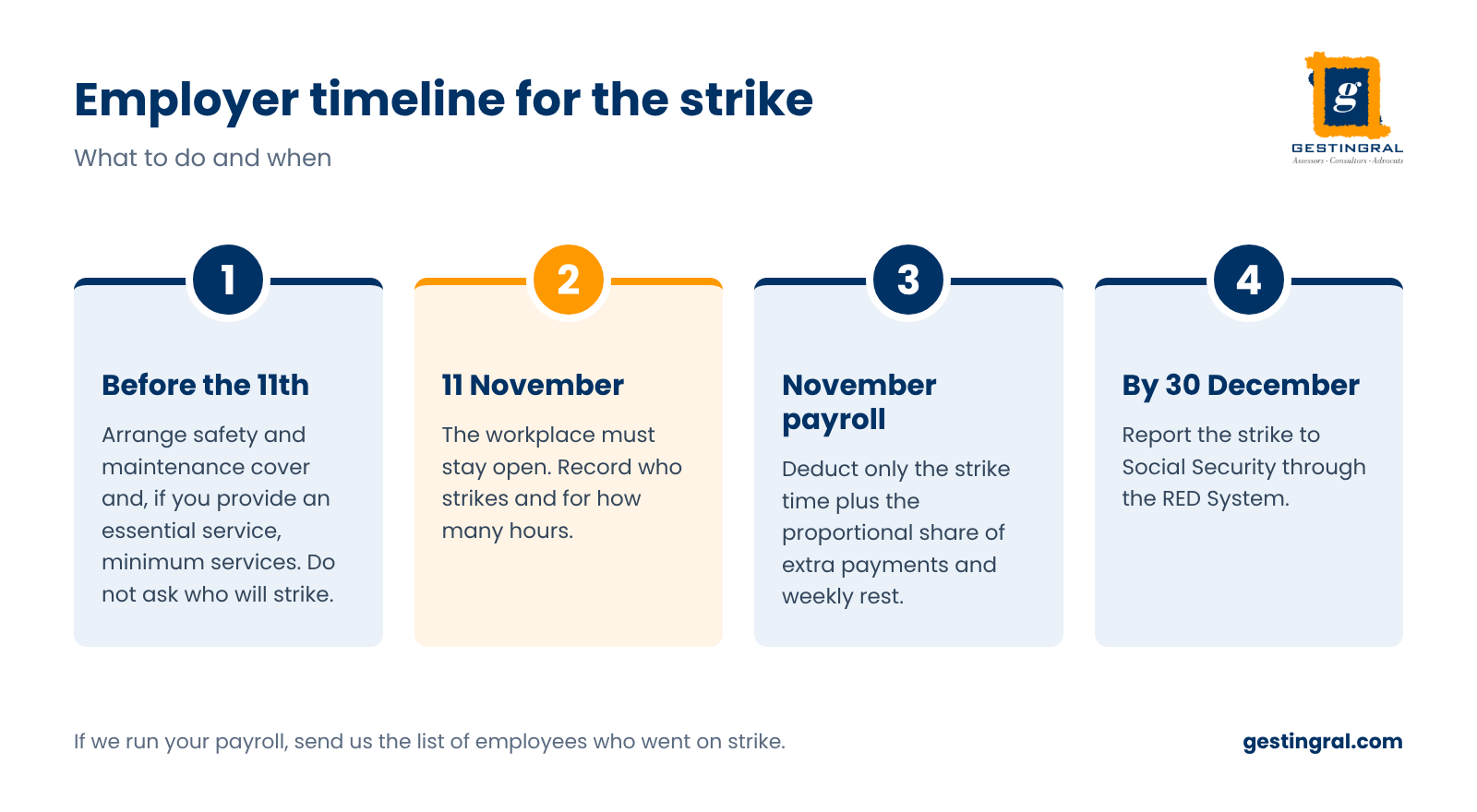
How does it affect November’s payroll?
Employees who strike lose pay for the time not worked, no more and no less (art. 6.2 of Royal Decree-Law 17/1977). The usual calculation covers the pay for the strike hours or day, the proportional share of the extra payments (pagas extra) and the proportional share of weekly rest. Holidays and public holidays are not affected. Attendance or productivity bonuses are only reduced if the collective agreement says so.
An example. An employee earns €1,800 a month in 14 payments (€25,200 a year), works Monday to Friday and strikes for the whole of 11 November:
- Pay per calendar day, including extra payments: €25,200 / 365 = €69.04
- Share of weekly rest (2 rest days for every 5 working days): €69.04 × 2/5 = €27.62
- Total payroll deduction: €96.66
This is an estimate. The final figure depends on the collective agreement and on how working time is distributed.
What about Social Security?
During the strike the employee is in a special registration status (alta especial): they remain registered, but neither they nor the employer pay contributions for that time (art. 6.3 of Royal Decree-Law 17/1977). The employer must report it to the General Treasury of Social Security through the RED System, the electronic channel used by employers and advisers. The deadline is the second-to-last day of the following month, which for this strike is 30 December 2026.
On the 11th itself, record who went on strike and for how many hours. If we run your payroll, send us that list as soon as you can: we will use it to calculate the deductions and report to Social Security on time.
If you are unsure how to organise things on the day, get in touch and we will advise you.
